Personal Digital Identity vs Professional Digital Identity
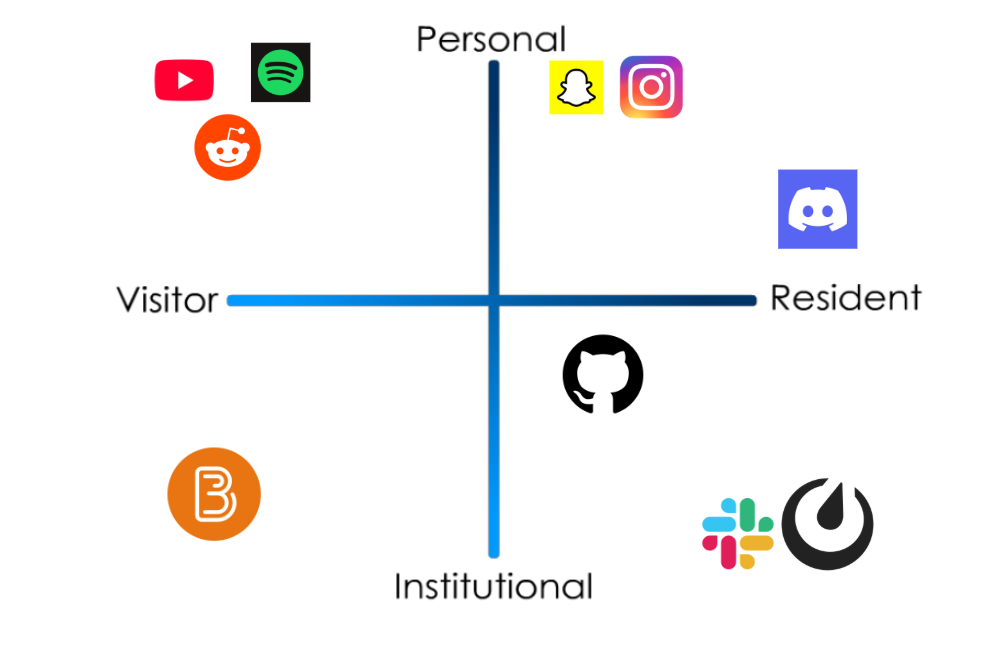
Overall, my map shows stronger Resident engagement in personal spaces and growing resident engagement in professional spaces. I think its only natural since I am definitely becoming more intentional about building a visible professional digital identity as I approach graduation. In the Personal-Visitor quadrant, Youtube, Reddit, and Spotify are similarly grouped because I only use it to consume media, never to post or interact with anyone. The Personal-Resident quadrant has Snapchat, Instagram, and Discord, where Snapchat and Instagram lean more towards visitor as I rarely post, but do frequently message my friends. Whereas, Discord leans more towards resident as its my main form of communicating with friends. UVIC also has a discord server which I use to communicate with peers of similar classes. Hence why it leans towards institutional. The Institutional-Visitor quadrant has Brightspace, where I only view course slides and submit assignments. The Insitutional-Resident quadrant includes Github, Slack, and Mattermost. Github is a collaborative version-control tool, where you can collaborate on projects with others (or by yourself.) Slack and Mattermost are quite similar where you communicate with your peers in a professional setting.
What digital platforms are students currently using to develop their professional network?
From personal experience as a CompSci major, most students use Github and LinkedIn to develop their professional network. Github works nicely as you can publicly store and showcase projects, demonstrate technical skills, and show collaboration experience. Employers often review GitHub profiles to access someone’s practical abilities. Although I didn’t include LinkedIn on my VR map, it is still a widely used platform among students for professional networking. LinkedIn primarily is used as a digital resume where students can connect with classmates, professors, and industry professionals.
What could the student consider in expanding their professional learning network?
To expand a PLN, students could move beyond passive participation and become more engaged on professional platforms. For example, contributing to public repositories on GitHub, and/or uploading personal projects. On LinkedIn, students could interact with posts, join industry-related groups, or connect with professionals whose work aligns with their interests.
Consider in your blog submission how an employer would respond if you applied for a job with them and they assessed your social media presence via your digital identity.
Fortunately, most of my personal social media accounts are private. I made an intentional effort to cover my personal digital identity, I use different names, a private email, different usernames, etc. I would imagine, if an employer where to do a background check, they wouldn’t find anything recent that is publicly available. Although, my digital security was not as secure when I was younger, and some online traces connected to relatives may still exists, any content found would not be relevant to my professional qualifications or the role itself.